Overview | Chronic heart failure in adults: diagnosis and management | Guidance | NICE
Chronic heart failure | Treatment summary | BNF content published by NICE
Sustainable One-Africa (SOA)
One Africa is an NGO
3.0 Products/ services
4.2 Target Market
Segment Strategy
4.3 Service Providers
Analysis
4.3.1 Alternatives and
Usage Patterns
5.0 Strategy and
Implementation Summary
7.3 Projected Surplus or
Deficit
7.3 Projected Surplus or
Deficit
3.0 Products/ services
areas : agriculture/farming/food production/environmental Sustainability/ Health promotion / Civic awareness/ patriotism ... and leadership
Le parcour des memoires/ The journey of memories : From childhood to-date
chaptres:
1. Introduction
This is my first book and it is intended for the readers to express my
2. from birth to 8 years
Treatment for coronary heart disease (CHD) can help manage the symptoms and reduce the risk of further problems.
CHD can be managed effectively with a combination of lifestyle changes, medicine and, in some cases, surgery.
With the right treatment, the symptoms of CHD can be reduced and the functioning of the heart improved.
If you've been diagnosed with coronary heart disease, making simple lifestyle changes can reduce your risk of having further episodes.
For example, stopping smoking after a heart attack quickly reduces your risk of having a heart attack in the future to near that of a non-smoker.
Other lifestyle changes, such as eating more healthily and doing regular exercise, will also reduce your future risk of heart disease.
Read more about preventing CHD.
Many different medicines are used to treat CHD. Usually they either aim to reduce blood pressure or widen your arteries.
Some heart medicines have side effects, so it may take a while to find one that works for you. A GP or specialist will discuss the various options with you.
Heart medicines should not be stopped suddenly without the advice of a doctor as there's a risk this may make your symptoms worse.
Blood thinners are a type of medicine that can help reduce the risk of a heart attack by thinning your blood and preventing it clotting.
Common blood-thinning medicines include:
If you have high cholesterol, cholesterol-lowering medicine called statins may be prescribed.
Examples include:
Statins work by blocking the formation of cholesterol and increasing the number of low-density lipoprotein (LDL) receptors in the liver.
This helps remove LDL cholesterol from your blood, which makes a heart attack less likely.
Not all statins are suitable for everyone, so you may need to try several different types until you find one that's suitable.
Beta blockers, including atenolol, bisoprolol, metoprolol and nebivolol, are often used to prevent angina and treat high blood pressure.
They work by blocking the effects of a particular hormone in the body, which slows down your heartbeat and improves blood flow.
Nitrates are used to widen your blood vessels. Doctors sometimes refer to nitrates as vasodilators.
They're available in a variety of forms, including tablets, sprays and skin patches such as glyceryl trinitrate and isosorbide mononitrate.
Nitrates work by relaxing your blood vessels, letting more blood pass through them. This lowers your blood pressure and relieves any heart pain you have.
Nitrates can have some mild side effects, including headaches, dizziness and flushed skin.
ACE inhibitors are commonly used to treat high blood pressure. Examples include ramipril and lisinopril.
They block the activity of a hormone called angiotensin-2, which causes the blood vessels to narrow.
As well as stopping the heart working so hard, ACE inhibitors improve the flow of blood around the body.
Your blood pressure will be monitored while you're taking ACE inhibitors, and regular blood tests will be needed to check that your kidneys are working properly.
Less than 1 in 100 people have problems with the blood supply to their kidneys (renal stenosis) as a result of taking ACE inhibitors.
Side effects of ACE inhibitors can include a dry cough and dizziness.
Angiotensin-2 receptor blockers (ARBs) work in a similar way to ACE inhibitors.
They're used to lower your blood pressure by blocking angiotensin-2.
Mild dizziness is usually the only side effect. They're often prescribed as an alternative to ACE inhibitors, as they do not cause a dry cough.
If you have coronavirus (COVID-19), or think you might have it, keep taking your blood pressure medicines as usual.
There is no clear evidence that taking angiotensin-converting enzyme (ACE) inhibitors or angiotensin-2 receptor blockers (ARBs) will cause complications.
Calcium channel blockers also work to decrease blood pressure by relaxing the muscles that make up the walls of your arteries.
This causes the arteries to become wider, reducing your blood pressure.
Examples include amlodipine, verapamil and diltiazem.
Side effects include headaches and facial flushing, but these are mild and usually decrease over time.
Sometimes known as water pills, diuretics work by flushing excess water and salt from the body through urine.
If your blood vessels are narrow as the result of a build-up of atheroma (fatty deposits) or if your symptoms cannot be controlled using medicines, interventional procedures or surgery may be needed to open up or bypass blocked arteries.
Here are some of the main procedures used to treat blocked arteries.
Coronary angioplasty is also known as percutaneous coronary intervention (PCI), percutaneous transluminal coronary angioplasty (PTCA) or balloon angioplasty.
Angioplasty may be a planned procedure for someone with angina, or an urgent treatment if the symptoms have become unstable.
Having a coronary angiogram (a type of X-ray used to check blood vessels) will determine if you're suitable for treatment.
Coronary angioplasty is also performed as an emergency treatment during a heart attack.
During the procedure, a small balloon is inserted to push the fatty tissue in the narrowed artery outwards. This allows the blood to flow more easily.
A metal stent (a wire mesh tube) is usually placed in the artery to hold it open. Drug-eluting stents can also be used. These release medicines to stop the artery narrowing again.
Coronary artery bypass grafting (CABG) is also known as bypass surgery, a heart bypass, or coronary artery bypass surgery.
It's carried out in people whose arteries are narrowed or blocked.
A coronary angiogram will determine if you're suitable for treatment.
Off-pump coronary artery bypass (OPCAB) is a type of coronary artery bypass surgery. It's performed while the heart continues to pump blood by itself without the need for a heart-lung machine.
A blood vessel is inserted (grafted) between the main artery leaving the heart (the aorta) and a part of the coronary artery beyond the narrowed or blocked area.
Sometimes, an artery that supplies blood to the chest wall is used and diverted to one of the heart arteries. This allows the blood to bypass (get around) the narrowed sections of coronary arteries.
Occasionally, when the heart is severely damaged and medicine is not effective, or when the heart becomes unable to adequately pump blood around the body (heart failure), a heart transplant may be needed.
A heart transplant involves replacing a heart that's damaged or is not working properly with a healthy donor heart.
Each of the twelve electrocardiogram leads, records specific information from the different areas of the heart.
Naturally, each lead provides more information from the nearest wall tan distant walls (electrically speaking).
For example: the inferior leads provide more information from the inferior wall of the heart than the rest of the walls.
That is why we group the leads of the electrocardiogram depending on the nearest heart wall.
These groups have major relevance in ischemic heart disease. In acute ST elevation infarction, electrocardiogram allows us to locate the occluded artery, and in patients with previous infarction, Q wave locates areas of myocardial infarction.
We can distinguish three groups of leads, which are anatomically correlated with anterior, inferior and lateral walls of the left ventricle. There is also another group that provides information on the right ventricle.
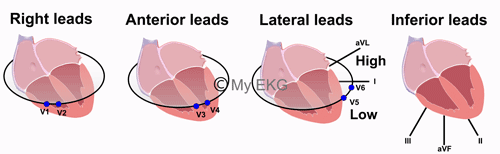
Right, anterior, lateral and inferior leads of the EKG
To confirm right ventricular abnormalities is recommended also make the right-side Leads (V3R, V4R, V5R, and V6R).
Alterations in the posterior wall are seen in V1-V3 as reciprocal image. It is recommended make the posterior leads to confirm the information.
In the next article we will further explain QRS complex morphology. Click on next down below to stay

